| List of historic valves in the ase-museoedelpro collection |
| |
| Here
is a list of some historic valves in the collection, including a survey of
early valves, up to mid 1930s, power and transmitting tubes, VHF and UHF
types, tubes designed for radar application and several very early prototypes
designed and built during the radar development in England, Germany and in
the US: magnetrons, klystrons, and conventional gridded types. There are also
more recent types added because of their operating principles or even because
they are evolutions of early types. |
The
ASE-Museoedelpro collection includes several hundred types of valves. This is
only a partial list that will be updated as other valves cards are
ready.
Some links could still left open, please access from the Virtual Museum
selection. *** Last update: March 2026. |
|
|
| 1B42 |
Mercury spark gap, radar
pulse modulator. Western Electric Mercury pool was used to continually renew
the surface of the negative electrode.
200 A at 6 µs pulses.
Description in the BSTJ Vol. 25, Oct. 1946 and in Glasoe, Pulse Generators,
Rad Lab Series, |
|
|
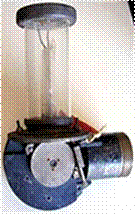
| 2H21 |
Phasitron'
FM modulator, General Electric, 1950s. Also available the 5593, different
parameters. |
|
|
| 2J21
/ 2J21A |
Magnetron,
very early unstrapped X-band, 1941. Westinghouse. Rare, superseded from 1942
by the WE 725A. |
|
|
| 2J22 ÷ 2J29 |
Family of
S-band magnetrons. 250 kW typical pulses |
|
|
| 2J36 |
12-vane
X-band magnetron. Still unstrapped, it was released early in 1942, being
registered to Raytheon only after the war, in October 1945. Used in the
AN/MPN-1 ground controlled precision approach radar system. |
|
|
| 2J38 / 2J39 |
Fixed
frequency low power magnetrons operating at 3.300 MHz. Integral magnet.
Coaxial output.Registered to Raytheon in October 1945, RMA record 445. |
|
|
| 2J51A |
Packaged
magnetron, mechanically tunable from 8.5 to 9.6 GHz. 20 to 70 kW peak power
by moving one to four magnetic shunts. Western Electric. Full description
given in 1946 in the Bell System Technical Journal. |
|
|
| 2J55 / 2J56 |
Fixed
frequency variants of the packaged 2J51A |
|
|
| 2J61(A)/ 2J62(A) |
Mechanically
tunable S-band magnetrons with overlapping frequency coverage. Designed to
replace the family of fixed frequency types 706AY to 706GY.
Registered to Raytheon in October 1945, RMA record No. 445. |
|
|
| 2K33 (A,B) |
Raytheon
K-band reflex klystron. Derived from early prototypes of VX302 developed in
UK at the Clarendon Laboratory from 1941. In the UK the devvelopment of the
24 GHz radar was abandoned due to the excessive attenuation caused by water
vapor. |
|
|
| 2K50 |
K-band reflex klystron developed in
1944 by Western Electric. Thermally tuned by electronic bombardment.
Waveguide flange. |
|
|
| 3B600 |
Power
triode intended for electro-medical applications. Fivre |
|
|
| 3C27(B)/3C37 |
UHF power triode, National Union proposed its own
variants of the British milli-micropup family. Flying wires replaced by
coaxial connector and in the 3C37 a finned radiator was added to the grid
rod, for better pulse operation when the grid was heavily d |
|
|
| 3F3-TRX |
Forced-air cooledn 3 kW transmitting triode. Fivre |
|
|
| 3F20-TA |
Transmitting triode, external radiator or water
jacket. 22 kW. Fivre |
|
|
| 3F22-TA |
Transmitting
triode, compact folded anode variant of the 3F20-TA. Fivre |
|
|
| 4C27 |
UHF
transmitting triode, 'micropup' style. U.S. equivalent to British CV92,
CV199, NT99 and to Canadian REL 7 |
|
|
| 4C28 |
UHF
transmitting triode, 'micropup' style. RCA variant of the 4C27, for the
SHORAN navigation system. |
|
|
| 4C29 |
UHF
transmitting triode, 'micropup' style. Flying leads replaced by a coaxial
connector. Registered in the U.S. by Canadian REL. Manufactured by Canadian
Rogers and by Central Sales in the U.S. |
|
|
| 4J52 (A) |
Packaged
X-band magnetron. RMA registration reserved to Western Electric in November
1944, registered only after the war, in October 1948. RMA record No.
703. |
|
|
| 4J57 |
Packaged
magnetron operating in the C-band. 250 kW. Registered to Raytheon in 1946. |
|
|
| 5J26 |
600 kW
magnetron, mechanically tunable from 1.220 to 1.350 MHz. Intended to replate
the entire family of fixed frequency types from 4J21 to 4J30. Western
Electric during WWII |
|
|
| 5J29 |
Split
anode CW magnetron, liquid cooled. General Electric developmental code ZP579.
It was designed to operate from 350 to 770 MHz in the radar jammer AN/APT-4 |
|
|
| 5J30 |
Split
anode CW magnetron, liquid cooled. General Electric developmental code ZP590.
It was designed to operate from 150 to 385 MHz in the radar jammer AN/APT-4. |
|
|
| 5J32 |
Split
anode CW magnetron, liquid cooled. Coaxial copper tubes for liquid cooling of
the anode blocks. General Electric. It was designed to operate from 350 to
750 MHz in the radar jammer AN/APT-4. |
|
|
| 5J33 |
Split
anode CW magnetron, liquid cooled. Three anode segments, the central one
connected to the mid point of the line.
General Electric. It was designed to operate from 750 to 1.150 MHz in
the radar jammer AN/APT-4. |
|
|
| 6C21 |
Eimac
power triode derived from the 1000T.Intended as power pulse modulator |
|
|
| 8P1 |
Ultra hi-rel pentode designed by British GPO to
operate in submarine cable repeaters, system life expectancy exceeding 20 years. Quite
late, 1962, and extremely rare.
Only evaluation prototypes
made before submarine cables were replaced by communication |
|
***** |
| 10AL1 |
Reflex klystron, British early
experimental prototype in order to improve the 'Sutton tube'. It shows a flat repeller, such as in the WE 707A
and close interaction with the electron beam by means of meshes of molybdenum
ribbon on the resonator ends. This solution will be later adopted in the new
S-band klystron family, as in the CV238.
Second half of 1941. |
|
***** |
| 10E501
/ CV11 |
Early reflex klystron, designed by
Robert Sutton in 1940 as local oscillator for microwave radar receivers. Also
known as 'Sutton tube'. The collection also includes an unbased
prototype.
This and the unbased one are
the only known samples of the original 'Sutton tube'.
** September 1940 onwards. |
|
***** |
| 35T-
Vacuum Gauge |
Eimac ionization vacuum gauge, derived from 35T
transmitting triode. Likely used in the evacuation system of the 'resnatron'
1 MW tetrode. |
|
|
| 53A |
Eimac VHF
transmitting triode. Smaller than other similar triodes, 227, 327 and
VT-127.Probably used in the transmitter of ASB airborne radar |
|
|
| 175HQ |
Ultra high rel amplifier for submarine
cables designed by Bell Telephone. Used in the Avana-Key West and in the
TAT-1 transatlantic cables. Designed
for system life exceeding 20 years!
June 1941 onwards.
***Extremely rare |
|
***** |
| 356A
/ 356B |
VHF power triode, derived from the 100TH. Used in
the modulator of the early CXAS radar. The gridless variant was proposed as
705A, high-voltage rectifier. Western Electric and British STC. |
|
|
| 357A
/ 357B |
VHF transmitting triode. Western Electric and later
Machlett |
|
|
| 364A |
VHF all-glass transmitting triode.
Western Electric. Pre-WWII, used in WE radio links.
According to Ludwell Sibley, used since 1939 in the Massachusetts coasts to
Cape Charles and later in the Cheasepeak Bay radio links.
*** Very rare |
|
|
| 402A |
Early
Western Electric linear-beam klystron amplifier. This is the only one gone
into small production of the many experimental types made at Bell Labs around
1940.*Rare! |
|
|
| 410
Westinghouse |
Early power klystron developed by the
Varian brothers and gone into limited production in the US around 1940. 10 W
out at 3 GHz. Complete with Type 10 tuner.
** Very rare! |
|
***** |
| 455A |
Ultra high-rel amplifier for submarine
cables. Designed to operate 20 years with no failure, in order to replace the
175HQ for the new SD transoceanic system. The tubes were built by Weswtern
Electric.
Each tube was aged for 5.000
hours.
**** Extremely rare! |
|
***** |
| 527A / PL-185 |
VHF power
triode used as radar oscillator or modulator. Four tubes in the ring
oscillator of SK-1M set gave 1 MW at 225 MHz. Eimac was second sourced by
Penta Labs with its code PL-185. |
|
|
| 700B |
The 700A-D were the first cavity
magnetrons designed by Westren Electric after the Tizard Mission revealed
progress with the E1189 magnetron. Early 1941. *** Very rare! |
|
***** |
| 701A |
Power
tetrode proposed as pulse modulator. Large glass bulb containing four
electrode sets of the 350A with common molybdenum plate. Western Electric,
1941 |
|
|
| 706A-C (Y) |
Early Western Electric family of S-band magnetrons. Introduced only after
the six-cavity 700, the unstrapped 706 was available in three frequency
variants, A to C.The strapped version, Y suffix, included more frequency
variants, from A to G. |
|
|
| 714A(Y) |
Western
Electric early magnetron, similar to 706A but t operating at 3.300 MHz. |
|
|
| 720CY |
1 MW S-band WE magnetron. To increase
the emission, the cathode and obviously the anode length were doubled with
respect to the dimension of the 714 family |
|
|
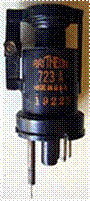
| 723A (A/B) |
In the US
the design of the 723A (in the photo), the first reflex klystron for the
receiver of the X-band radar, started at WE in the first half of 1941. The
resonator was moved into the evacuated metal envelope and the tuning was
possible from the outsid |
|
|
| 725A |
The
X-band strapped magnetron 725A was designed at Western Electric to replace
the 2J21. During WWII its production exceeded 250.000 units, more than 90.000
of which supplied to the British Empire under the Lend-Lease law. |
|
|
| 728DY |
200 kW
UHF magnetron family, A to J suffixes covering from 900 to 970 MHz. |
|
|
| 730A |
The
Western Electric 730A was similar to the 725A above, with the WG flange
rotated 90 degrees. |
|
|
| 880
/ GL-880 |
Folded anode 20 kW transmitting triode requiring
external water jacket. The very compact arrangement of the electrodes also
offers improved frequency performance.
An excellent demonstrator of glass-to-copper welding technology. |
|
|
| 891
/ 891R |
The rated power of the water-cooled 891 triode was
7 kW. The 891R with finned radiator
was rated at 4 kW with forced-air cooling.
*** This sample, made by Italian Fivre, survived the shipping to us despite
its mass of over 20 kg.*** |
|
|
| 3036D |
LMT UHF retarding-field triode for
Barkhausen-Kurz oscillator. Early in the 1930s this was the simplest way to
generate frequencies above 100 MHz. Unfortunately the obtainable power was
very low, in the order of a few milliwatts. |
|
|
| 6090 |
Electrostatic
beam switch/multiplexer. National Union.*Measurements, rare! |
|
|
| 4316A |
British
STC equivalent for the WE 316A 'doorknob' style UHF triode. The 316A was used
in the early eperiments of AI radar, as reported by Bowen. Due to the complex
manufacturing process and to the introduction of better performing types by
GEC, in England |
|
|
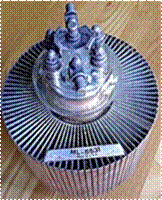
| 5531 |
Transmitting
power triode, forced-air cooled. 10 kW power dissipation. Registered to
Western Electric in february 1949, RMA release 734. |
|
|
| 5586 |
Pulse
magnetron tunable from 2.7 to 2.9 GHz. Replaced the family of fixed frequency
types 4J31 to 4J35. 800 kW typical output power. |
|
|
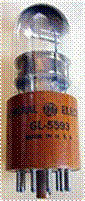
| 5593 |
General
Electric 'Phasitron' FM modulator tube. The principle was first introduced by
Robert Adler at Zenth Radio in January 1946. Similar to GE 2H21, different
operating parameters. |
|
|
| 5680 / 7C23 |
2.5 kW
power triode, finned radiator also intended for pulsed operation with 35 A
peak emission. |
|
|
| 6090 |
Electrostatic
beam switch multiplexer. National Union |
|
|
| 6230 / QK299A |
Mechanically
tunable magnetron, integral magnet, wg out. Used in the active guidance of
the Nike-Ajax and in the AN/UPW-1 X-band data link. Raytheon. |
|
|
| 6324 |
25-line
magnetically focused beam switch/multiplexer. National Union*Measurements,
rare! |
|
|
| 6344A / QK235 |
Tunable
magnetron, integral magnet. 260 kW typical from 5.450 to 5.825 MHz. |
|
|
| 6410 / QK338 |
High
power packaged magnetron. 5 MW pulses at 2.750 to 2.860 MHz. This sample,
still in its factory shipping crate, was manufactured by ElTel. |
|
|
| 6896 / 1855 |
RCA
'Graphecon' scan converter tube. Dual gun tube, basically designed to convert
ppi images in a format compatible with raster video monitors |
|
|
| 7003
/ ML-7003 |
Screened control grid power triode
intended to operate as pulse modulator up to 2 MW. Grid wires are protected
from direct strikes of electrons when grid is heavily driven positive during
pulses. |
|
|
| 7503 |
Low power
X-band magnetron for beacon application. 200 W peak output power. |
|
|
| A-103A |
Experimental split-anode magnetron
w/internal loop, probably proposed by RCA in 1941 to operate as local
oscillator at 3 GHz. Later registered
as 3J35, no known use. |
|
|
| A1396B |
RCA
experimental beam-deflection amplifier, probably made in the development of
the 1636 UHF mixer Experimental, very rare! |
|
|
| ACT25
/ CV436 |
In 1943 GEC introduced the CV288 triode
for CW and pulse operation up to 600 MHz. After the war the design was
proposed again in the ACT25 wide band UHF power amplifier |
|
|
| AS1010
AEG |
German
WWII UHF high-power twin triode for pulse operation. *** Extremely rare! *** |
|
|
| AT50 |
50W 'Three-foot' style early
transmitting triode. Early 1920s |
|
|
| AV1015 |
Power
triode, pulse modulator |
|
|
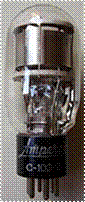
| C100A |
Quite unique external-grid oscillator
designed by Amperex for Collins around the mid thirties. This kind of
non-conventional oscillator had been patented in 1915 by Dr. Robert Goddard,
the scientist known for his works on rockets. |
|
|
| C100D |
Negative resistance oscillator,
designed by Amperex for Collins as improved variant of the C100A |
|
|
| C31007C13 |
RCA
experimental 10-stage photomultiplier. No data |
|
|
| Catkin-Prototype |
GEC
experimental 'Catkin' prototype with radiator. Derived fro the CAT
transmitting power tubes, the smaller Catkin family retained the external
copper anode sealed to the bottom glass bulb |
|
|
| CG-1162 / VT-14 |
General
Electric pliotron, early transmitting triode, introduced during the Great
War. Two variants available with two or with four plate supporting strips. |
|
|
| CV8 / E1248 |
Coaxial
diode, micropup style, designed to operate as T/R switch in the duplexer of
the Naval Type 270B radar. GEC, 1941 |
|
|
| CV14 |
Silica' transmitting triode designed to operate in
VHF RDF sets. Operation proved to be marginal above 150 MHz and micropup
triodes were preferredAbout 1941. *** Rare |
|
|
| CV15 |
Micropup' style transmitting triode,
conduction-cooled. Intended to operate in the VHF region, up to 300 MHz |
|
|
| CV22 |
Mercury
thyratron designed for high-power pulser, 50 A at 20 kV. BTH |
|
|
| CV55
/ CV155 / CV178 |
Milli-micropup power triodes, useful for CW or
pulsed operation up to 1.200 MHz. In radar applications two CV155s generated
40 kW pulses at 1.200 MHz. Developed at GEC from the late 1939 to 1940. |
|
|
| CV56(*) |
Early strapped variant of NT98, used among the
others in the Type 271Q Naval radar. Soon later supplied in four frequency
variants, A to D suffixes from the 1943 production. Frequency variants
available, idntified for their suffix A to D. |
|
|
| CV58 / CV258 |
Planar
diode, UHF mixer |
|
|
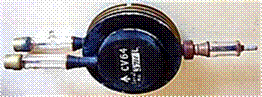
| CV64 |
Strapped variant of the E1198/CV38 magnetron.
Developed by BTH, it was used in the H2S transmitter. See also the Canadian
REL 3C and the German copy LMS 10. |
|
|
| CV69 |
The first strapped cavity magnetron capable of
operation at 1 MW input power. Used in the Type 271 Naval radar set. CV69A to
D were later relisted as CV1475, CV1476, CV1477 and CV 1478 |
|
|
| CV76 |
High power
variant of CV56 operating with higher magnetic field. 25 kV at 40A input
pulses. Used since early 1943 in the Type 277 early warning radar. |
|
|
| CV87 / KRN2 |
Early
X-band reflex klystron using the harmonic resonator proposed by Blumlein at
EMI in close collaboration with the Clarendon Laboratory. First samples were
available by March 1941. |
|
|
| CV94 / DS103 |
Coaxial
diode, T/R switch, probably designed to replace the CV8. Used in the Naval
Type 960 radar, 450 kW. 100 A peak cathode emission. About 1945. |
|
|
| CV109
/ 9PK5 |
First British power klystron, Only few experimental
samples made in 1940, being outperformed by the E1189 cavity magnetron. 150 W
at 10 cm.*** Extremely rare!!! |
|
***** |
| CV150
/ PK150 |
10 cm power klystron designed by EMI in 1941 for
the transmitter TR 3539 for airborne radar set. 30 kW peak power. The design
of this klystron was requested by Winston Churchill himself for the radar
sets of aircraft on missions on the continent, thus preventing the enemy
could capture the cavity magnetron.*** Exremely rare!!! |
|
***** |
| CV160 |
1 MW S-band high power magnetron. Coaxial output.
1944 |
|
|
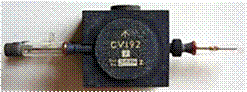
| CV192 |
High-power variant of the CV64, to be used in
pressurized execution of the H2S airborne radar. Conduction cooled from the
heavy metal block. |
|
|
| CV208
/ E1487 |
GEC early strapped X-band magnetron The collection
includes two samples, one with wg adapter/mount and duoble heater stem, the
second one with single stem. |
|
***** |
| CV209
/ MX57 |
BTH early strapped X-band magnetron. Mechanically
and electrically compatible with GEC CV206 |
|
***** |
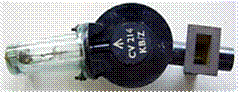
| CV214 / E1531 |
GEC
variant of CV208 with waveguide flange and protective glass boot. |
|
|
| CV230 |
Heil tube
oscillator. Probably proposed as local oscillator for the 10 cm radar
receiver.*** Exremely rare!!! |
|
|
| CV240
/ E1495 |
GEC high-power triode, micropup style. 125 A
emission at 15 kV max anode voltage. 100 MHz. Design started in April 1944. |
|
|
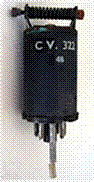
| CV322 |
British
reflex klystron, functionally equivalent to WE 723A/B. The CV322 title
applies to the same 723A/BProbably just few prototypes made in the second
half of 1941, waiting for the release of the WE 723A |
|
|
| CV381 / BT85 |
BTH
hydrogen filled thyratron. 90 A at 10 kV. 2500 pps max pulse repetition rate.
The sample was in service on the HMS Trenchant. |
|
|
| CV1025 / VT25 |
Transmitting
triode with L4 base. 36 W plate power. Also known as DET25. |
|
|
| CV1030
/ VT30 |
Early MOV 250 W transmitting triode. Introduced as
T250, it was accepted by British Post Office as VT30 and by Royal Air Force
as 10E/8738. Later, different codes were unified under the title CV1030.1922
- Rare |
|
|
| CV1031
/ VT31 |
Early British 250 W transmitting tetrode. |
|
|
| CV1090
/ E1046 |
First 'micropup' VHF transmitting triode, GEC
design code E1046. Also known as VT90. Introduced in 1939 with the early AI
and ASV radar sets, it was produced through WWII in several countries, US,
Canada, Australia, with different codes.One of the most popular VHF power
triode in WWII. |
|
|
| CV1098
/ E960T / REL5 / VT98 |
VHF transmitting triode for pulse operation.
Derived from MOV ACT10 early TV transmitting triode.Used in the CHL radar
system. Also made for REL by Canadian Westinghouse for the Panama Channel
surveillance system.1939 variant of the 1938 E960/VT58, with thoriated-tungsten
filament. |
|
|
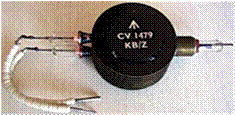
| CV1479 ÷ CV1482 |
Family of
magnetron tubes which replace CV79A to CV79D frequency selections. |
|
|
| CV1483 ÷ CV1486 |
High power
magnetron fsmily, replacement for CV99A to CV99D. 400 kW. |
|
|
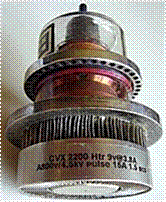
| CV2222 / CVX2222 |
Power
triode capable of operation up to 1.5 GHz. Probably evolved from the wartime
CV288. |
|
|
| CV2341 |
Marconi
coaxial saturated diode, noise generator.*Measurements, rare! |
|
|
| CW10 |
Osram early split-anode magnetron.About 1936, rare! |
|
|
| D-75910 |
Western
Electric vacuum ionization gauge*Measurements, rare! |
|
|
| D-75912 |
Western
Electric vacuum ionization gauge*Measurements, rare! |
|
|
| DS323 |
Lorenz UHF power triode. Early type, about 1939,
replaced by RD12Tf from 1941.Rare!!! |
|
|
| DV27 |
Heil tube oscillator, 3 GHzOnly experimental
samples, very rare! |
|
|
| DV57 |
Heil tube oscillator, 10 GHzOnly experimental
samples, very rare! |
|
***** |
| E880
/ NT75 proto #1 |
Megaw's split-anode four-segment magnetron built
during the development of the E880/NT75 for the transmitter of a ship-to-ship
secure communication system commissioned by the Admiralty. About 1937, coming
from the today dispersed GEC collection.Megaw's experimental prototype,
1936/1937 |
|
*****
Megaw's notes on this magnetron can be read here. |
| E880
/ NT75 proto #2 |
Split-anode four-segment magnetron built during the
development of the E880/NT75. Similar to the previous one, with small
differences in the end connections of the filamentary cathode.
About 1937, same source as for the previous one.Megaw's experimental
prototype, 1936/1937 |
|
***** |
| E880
/ NT75 proto #3 |
This sample has the same four-segmant split-anode
design of the other two E880 prototypes but it is fitted with an additional
grid wire for direct modulation of the carrier. Megaw's experimental
prototype, 1936/1937
*** ABSOLUTELY UNIQUE *** |
|
***** |
| E1189_Early_Prototype ******************** |
This is the very early prototype of the
eight-cavity E1189 magnetron. It was the first one of a lot of four 8-segment
units to operate on the bench, while connected to the vacuum pump at the end
of July 1940. It was designed and used by Megaw for laboratory test and life
endurance evaluation of the oxide-coated cathode. The third one of the lot
was the E1189 No. 12 brought to America by the Tizard Mission.*** ABSOLUTELY
VERY UNIQUE *** |
|
to an article |
| ED702Ed |
Telefunken
microwave silicon diode, 1943 |
|
|
| ET1 |
MOV electrometer triode, 1936 - 1937*Measurements,
rare! |
|
|
| ET630
/ QK630 |
Stabilotron', crossed-field 'Amplitron' with
external cavity. Made by ElTel, equivalent to the Raytheon QK630.Rare sample
of cross-field amplifier, made in Palermo, Italy to Raytheon design. |
|
|
| GEC_Experimental
#1 |
Very early split-anode magnetron, verical structure
supported by glass rods. Probably made around 1932-1933 as prototype of the
NT52 magnetron with silica bulb.VERY UNIQUE SAMPLE OF POWER MAGNETRON FROM
EARLY 1930s! |
|
***** |
| GEC_Experimental
#2 |
Early high-frequency magnetron. 1934 or before. Not
sure but its design could be the E552.Megaw's experimental sample! |
|
***** |
| GEC_Experimental
#3 |
Early
gridded magnetron prototype. Vertical structure, spiral wound modulating
grid. 1935 ???Megaw's experimental gridded sample! |
|
***** |
| GEC_Experimental
#4 |
Split-anode
experimental gridded magnetron designed by Megaw for a ship-to-ship secure
communication system. The bi-filar grid was added for investigating the
direct modulation of the RF signal.
About 1937, coming from the today dispersed GEC collection, its photo
appearing in the book 'The GEC Research Laboratories, 1919 - 1984.Megaw's
experimental gridded sample! |
|
***** |
| GEC_Experimental
#5 |
Split-anode
experimental magnetron designed by Eric Megaw to investigate operation in the
microwave region. Believed to operate at 3 GHz or more.
Coming from the today dispersed GEC Research Laboratories
collection.Megaw's experimental sample! |
|
***** |
| German_magnetron_unknown |
German
split-anode magnetron with built-in back-loop. Believed to be a Siemens
magnetron made in 1943 for the Roderich jammer, according to a design made in
1937 at the Reichpost Developmental Department.
Kindly supplied by Karl-Heinz Gollmann.*** Exceptionally rare German
magnetron! |
|
***** |
| LBS-1 |
Electrostatic
deflection 10-position beam switch tube. Announced in 1955 by National
Union.*Measurements, rare! |
|
|
| LG75 |
German TR
switch |
|
|
| LG76
= CV76 |
German
copy of the CV76 T/R switch. The sample was probaly used in the ealy
experiments on the proper gas mixture to protect the diode mixer, since it
has a small hole to the glass wall. Exceptionally rare! |
|
|
| LMS10 |
German
strapped 8-cavity magnetron operating in the 10-cm band. Copy of the British
CV64 after the capture of a H2S radar in the crash of a British bomber near
to Rotterdam early in 1943. About 1.000 units made, most of which damaged in
the crashes of German fighters as for our sample.
*** Very rare, about 1.000 units made in WWII! |
|
***** |
| LMS12 |
X-band
German cavity magnetron built to an almost unknown Telefunken design. AKA
LM566/3
Believed to be the only sample today survived, it was stored somewhere at
the US War Department.***Ultra rare, about 50 made!!! |
|
***** |
| LMS13 |
18 GHz
variant of the LMS12. Still in the pre-production or sampling status before
the end of WWII. Almost certainly this is the only sample today survived,
coming from a basement of the US War Department.*** Quite unique sample! |
|
***** |
| M-16
experimental |
This CSF
12-segment M-16 magnetron is one of the two experimental 12-segment samples
designed by Henri Gutton at CSF for his friend Megaw and brought to GEC in
May 1940 by Maurice Ponte. It was used by Megaw to test the oxide-coated
cathode before switching to the same solution for his E1189 No.2 cavity
magnetron. It fully shows signs of the severe use described by Megaw in his
1946 paper on the development steps of the E1189 magnetron. *** The only one
of two samples made in 1940!!! |
|
***** |
| Magnetic
field sensor CRT |
CRT
designed in 1938 at RCA, Harrison to evaluate intensity and direction of
magnetic fields. No data, but it was described in Electronics, June
1938.*Measurements, rare! |
|
|
| MD10/1900 |
Brown-Boveri
'Turbator', CW magnetron deisgned for UHF communication links. 10 to 15 W at
1.900 MHz. |
|
|
| MD10/2000 |
Brown-Boveri
'Turbator', CW magnetron deisgned for UHF communication links. 10 to 15 W at
2.000 MHz. |
|
|
| MD500/2400 |
Brown-Boveri
'Turbator', CW magnetron probably deisgned for RF heating. No data found: the
code indicates a power of 500 W but certainly such a value could not be
continuous, rather we must think to short bursts. |
|
|
| MF150/2400 |
Brown
Boveri 'Turbator', single-sided CW magnetron. The basic design joins an
eight-segment interdigital magnetron with a surrounding cavity which
terminates the external resonating line. Introduced in 1947, this CW
magnetron could give about 150 W at 240 |
|
|
| MT9 |
Marconi
600 W power transmitting triode. 1925, very rare! |
|
|
| NR14 |
Early
British Admiralty HF receiving triode |
|
|
| NT39 / CV1222 |
75 W
external anode transmitting triode. Was used in the long range Wireless Set
No. 23 |
|
|
| NT41A |
Silica
transmitting triode,
early metric RDF transmitters.About 1935-1936, very rare! |
|
|
| NT45A
/ CV1226 |
Silica
transmitting triode, HF communication.Rare! |
|
|
| NT46R |
Silica
transmitting triode, used in early metric RDF transmitters.About 1935-1936,
rare! |
|
|
| NT57D |
Silica
valve' transmitting triode designed to operate in the early British radar
sets. 1937*** Rare! |
|
|
| NT57T |
Silica
valve' transmitting triode designed to operate in the early British radar
sets. The T suffix indicates the variant with thoriated-tungsten emitter.
1939***Rare! |
|
|
| NT63A / CV1239 |
Silica
transmitting pentode***Rare! |
|
|
| NT86
/ CV1248 |
High-power
silica transmitting triode. Used to generate 1 MW pulses in RDF sets***Very
rare! |
|
|
| NT98
/ E1198 |
Early 10
cm cavity magnetron, Admiralty reference code for the E1189 GEC design.
Sometimes marked with the Admiralty Pattern AP W2510. The first cavity
magnetron. Rare! |
|
|
| NT100 |
Power
terrode, 'catkin' style with finned radiator. Intended as pulse modulator for
early unstrapped cavity magnetrons, such as E1189, REL 3C or REL 3D. Replaced
by CV85 trigatron from the end of 1942.*Very early pulse modulator, rare! |
|
|
| QS5033 |
Strapped
magnetronlaboratory prototype. Probably made at Birmingham by the Sayer's
group in 1941,***Experimental sample! |
|
***** |
| QK174C |
CW FM
magnetron. Frequency modulation is achieved by means of six auxiliary
electron beams directed to the resonators. Its principle was first proposed
at MIT and then explored in depth in Proceedings of IRE, July 1947.The
Raytheon QK174A was advertised in Electronics in February 1949, while the
QK174C was advertisend in March 1953. ***Very intriguing operation! Rare! |
|
|
| QK328 |
Raytheon
beam-deflection analog multiplier*Measurements, rare! |
|
|
| QK680 |
Raytheon
'Amplitron', crossed field magnetron amplifier***Rare! |
|
|
| QK707A |
Water-cooled
CW magnetron. It was intended for microwave ranges. This sample probably
dating around 1960 was built in Italy by ELSI, Elettronica Sicula, at the
time owned by Raytheon, with a fully qualified production line.***Likely used
in the microwave ovens delivered to Autogrill Pavesi service stations in the
late 1950s |
|
|
| R1001
/ 3C36 |
R1001 was
being developed by National Union at the end of WWII for UHF power
application. The 3C36 registration code was assigned in February 1946.
According to Ludwell Sibley there was no known production This sample
probably comes from the collection of the late Rodney Burman.Very rare, only
evaluation samples! |
|
|
| RD2Me |
Split-anode,
four-segment magnetron, designed in 1943 by Telefunken for the 9 cm Roderich
radar jammer.***Very rare, late 1943! |
|
|
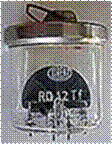
| RD12Tf |
UHF power
triode made by German Lorenz for pulse applications up to 600 MHz. Two used
in the transmitter of the FuG 200 Hoentweil radar, generating 30 kW pulses.
Evolved fron the DS323.WWII German radar technology! |
|
|
| REL
3C / E1198 |
Early
Canadian copy of the GEC E1198. Made by Northern Electric it was the
frequency variant of the GEC E1189, intended for airborne radar sets. Fully
equivalent to CV38.*Canadian early magnetron, 1941 |
|
|
| REL
3D / E1189 |
Early
Canadian copy of the GEC E1189. Made by Northern Electric it was used in some
radar sets designed and built by REL, such as the naval RX/C and the Canadian
GL3. 1941*Canadian early magnetron, 1941 |
|
|
| RM4025 |
Quasi-experimental
split-anode magnetron with internal resonator made by Siemens around 1944 or
1945. 10 GHz output frequency.Very rare! |
|
|
| RM4032 |
Quasi-experimental
FFO magnetron. About 50 units made. ***Very, very rare! |
|
|
| RS19 |
Very early
Telefunken transmitting triode, about 1919. |
|
|
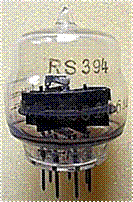
| RS394 |
UHF power
triode used in the transmitter of FuG202 Lichtestein radar since 1941.WWII
German radar technology! |
|
|
| RT323 |
Japanese
VHF transmitting triode. Designed by Toshiba for the Tachi No.7 radar set.
Instead of copper radiators of the English and American tubes, this tube has
a light alloy radiator, maybe aluminum.WWII Japanese radar technology
*Very rare! |
|
|
| RYG10 |
Very
early trochotron counter
Ericsson, 1954
*** Very rare *** |
|
|
| TAL12-35 |
Large
forced-air cooled transmitting triode made by Philips. In this valve various
technologies used in the combined processing of copper and glass can be
visually appreciated. |
|
|
| TAM1p5/100 |
1930s
Philips four-segment magnetron |
|
|
| TS1
/ TS1a |
GEMA UHF
transmitting triodes derived from WE 316. The base connection of TS1a is
reversed.WWII German radar technology. |
|
|
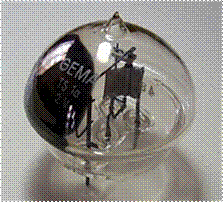
| TS2Sp-GEMA |
UHF
triode, GEMA early copy of 834 or WE 304A. About 1936, only few samples made,
being superseded by TS5***Very rare, quasi-experimental! |
|
|
| TS5 |
GEMA VHF
triode, ruggedized variant of WE 304A or of 8304WWII German radar technology.
Rare! |
|
|
| TS6 |
UHF
triode, 'giant doorknob' style. Two were used in the transmitter of the GEMA
marine radar Seetakt, giving 8 kW pulses.WWII German radar technology. Rare! |
|
|
| TS41 |
VHF
transmitting triode deigned for GE$MA radar sets.WWII German radar
technology. Rare! |
|
|
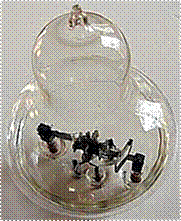
| TS60 |
UHF
triode, 'ship in the bottle' style, 1943 onwards. Used in the transmitter of
Wasserman and Jagdschloss radar systems. 100 to 150 kW pulse power.WWII
German radar technology.Ultra rare! |
|
|
| T-310 |
Japanese
UHF power triode. It recalls the Telefunken LS180 used in the Wurzburg radar
sets. Na data but likely this tube was designed for the Tachi 24 equivalent
to the German radar.*WWII Japanese radar. Ultra rare! |
|
***** |
| TWS-1 |
Early GEC
S-band TWT, 1960. Beleved to be the first TWT listed by GEC |
|
|
| VT-158
Zahl Tube |
Actually
the VT-158 is a power UHF oscillator, using four triodes in a
parallel/push-pull configuration, entirelly sealed in a compact glass bulb.
Designed between 1942 and 1943 by Dr. Zahl for the AN/TPS-3 radar.***Very
rare! |
|
***** |
| VT30
/ 10E8738 |
Early MOV 250 W transmitting triode.
Introduced as T250, it was accepted by British Post Office as VT30 and by
Royal Air Force as 10E/8738. Latei it was titled as CV1030.*Early 1920s.
Rare! |
|
|
| VX302 |
K-BandClarendon
Experimental klystron. The design was abandoned in England but it was
completed by Raytheon, originating the 2K33 and its frequency
variants.°Clarendon experimental sample! |
|
|
| VX6122
/ 19H12 |
Quasi-experimental
power damping diode intended for use in radar modulators. Eight diode systems
in parallel, all welded around a molybdenum cylinder. The bulb shape recalls
the one of the 833 transmitting triode. |
|
|
| XL7900 |
Actually
not a vacuum tube but a Philips vibrating capacitor, intended as low-noise
modulator for extremely feeble signals. It replaced electro-mechanic
choppers, making it possible to measure currents in the order of
femtoamperes, as low as 500 electrons per second!*Measurements, rare! |
|
|
|
|
|
|